
How can you protect steel from rust?
- 17 November 2022
- Published by: Andreas Janisch
- Category: Technology
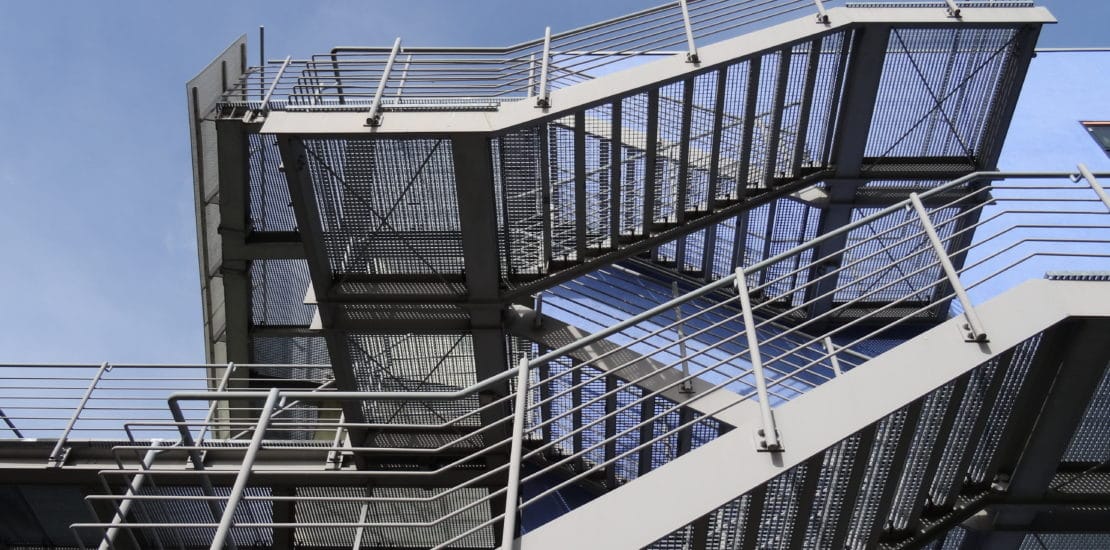
Steel is a highly versatile material. Steel is very strong and adaptable. Steel components such as bridges, railings or halls are inexpensive, simple and quick to erect. However, steel has one well-known weakness – rust.
Contents
If you expose unprotected steel to the weather, rusty spots appear after only a short time. To counteract this, steel always needs suitable rust protection. To understand how you can protect steel from rust, let us first look at how rust forms in the first place.
How does rust form?
Rust forms when the iron in steel reacts with oxygen from the air. This produces iron oxide, commonly known as rust. Moisture and salts accelerate this process. That is why rust protection is all the more important near the sea.
At first, rust is only a cosmetic problem, but as corrosion progresses, the components are weakened. The tube of a balcony railing then becomes thinner and thinner and could eventually buckle under load.
This is a safety risk and must not happen. That is why there are many ways of protecting steel structures from rust.
Rust protection by painting
There are various methods of protecting steel from rust. A very simple and inexpensive method is painting. Painting covers the steel with a layer of paint, so that the iron can no longer react with the oxygen in the air. This corrosion protection lasts as long as the paint layer is intact and free of cracks. After some time, the paint layer should be renewed to extend the protective effect. Cavities are problematic, as they are difficult or impossible to paint. This means there is no corrosion protection there. At least these areas are usually protected from moisture, so oxidation progresses more slowly. However, you should always try to preserve the cavities as well. If painting is not possible, you can also use cavity sealing.
Rust protection by powder coating
Powder coating works in a similar way to painting. Here, however, the coating is not applied with a brush or a spray head but with a special system. In a powder coating system, a coloured powder is electrostatically charged and then adheres to the workpiece. The component is then heated, causing the powder to bond with the surface to form a continuous coating.
Rust protection by galvanizing
With galvanizing, the zinc layer protects not only by enclosing the steel but also through cathodic corrosion protection. This is an additional protection resulting from the different electrical potential of the zinc layer and the steel. Instead of reacting with the steel, the oxygen first reacts with the zinc layer until it is used up. This works even with minor damage such as scratches, cuts or drill holes.
There are various processes for applying the zinc layer. For railings or larger steel beams, hot-dip galvanizing is usually chosen, in which the components are dipped into molten zinc. Another advantage of galvanizing is that the components are coated on the inside as well. However, holes must be drilled so that air can escape and the zinc can drain off.
More about galvanizing processes and costs.
Stainless steels
There are also steels that do not rust – at least not under normal conditions.
These steels are refined by adding the alloying elements chromium and nickel.
Depending on the proportion of alloying elements, there are different grades of stainless steel, e.g. V2A or V4A. In industry, other designations such as 304/316 or 1.4301/1.4401 are usually used.
It is important to know that these steels can also rust under certain conditions. Influencing factors include salt (sea), moisture, temperature or chemicals. The higher the requirements, the higher the proportion of alloying elements as a rule. Nickel is very expensive, which is why stainless steel is considerably more expensive than ordinary steel.
What is the cheapest way to protect steel from corrosion?
Painting or hot-dip galvanizing is usually the cheapest option. The cost difference for new components is not very large and also depends on the component geometry. For existing steel structures, painting is usually cheaper because the components do not have to be completely dismantled and transported. Stainless steel is considerably more expensive and is therefore usually only used for visual reasons, e.g. for railings, or in the process industry.
Which corrosion protection lasts the longest?
Stainless steel remains protected against corrosion the longest. Galvanized components are also resistant to rust for a very long time. If they are additionally painted, the protection period is extended enormously. Painted components that stand directly outdoors should be repainted after a few years.
Last revised on 2 December 2022 by Andreas Janisch