
Galvanizing – processes and costs compared
- 3 September 2017
- Published by: Andreas Janisch
- Category: Technology
What is galvanizing?
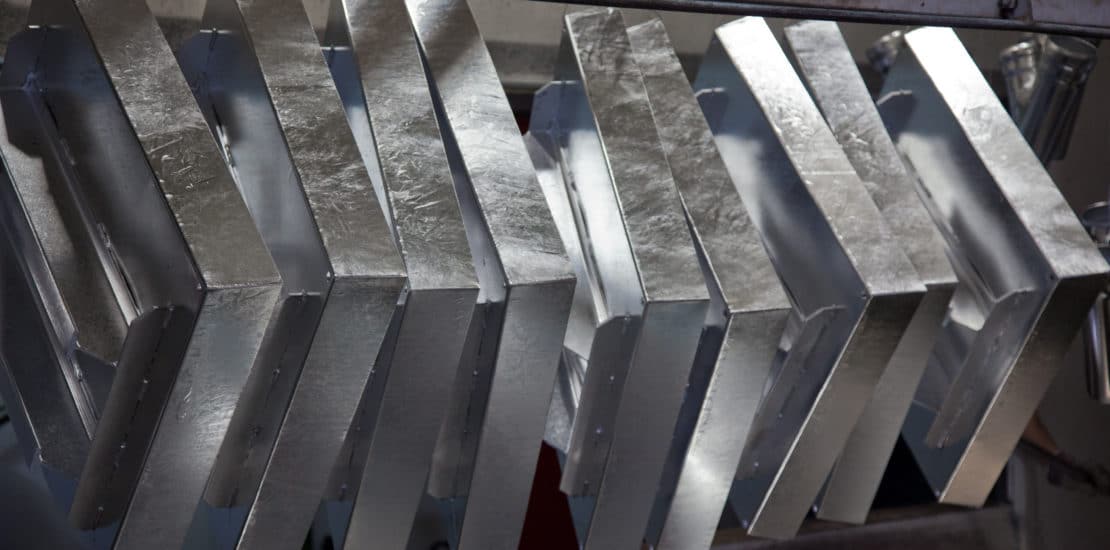
Galvanizing is a form of surface coating that protects steel particularly well against corrosion. In galvanizing, a thin layer of zinc is applied directly to the metal using various processes.
What are the advantages of galvanizing over painting?
While conventional coatings such as paint or powder coating protect a component by preventing a reaction with oxygen (oxidation), galvanizing additionally provides cathodic corrosion protection. As a result, the steel remains protected against corrosion even in the event of minor damage such as scratches, cuts, drill holes or at edges.
Galvanized steel can be exposed to the weather for many years without any problems, and even minor damage has no effect on the stability of the steel. With painted components, on the other hand, damage must be repaired to prevent rust from eating through.
What is cathodic corrosion protection?
The zinc in the coating is less noble than the steel structure underneath. The zinc layer therefore acts as a so-called sacrificial anode that oxidizes first. This means that the underlying steel structure is protected against corrosion until the zinc layer is used up. This protection remains even if the surface is damaged and lasts for a very long time.
Can galvanized components rust?
Galvanizing offers very good corrosion protection, but rust can still appear over time. When using galvanized components, you should bear the following points in mind:
- To prevent corrosion, larger areas of surface damage should be touched up. You can use zinc dust paint for this.
- The environment of the components affects the service life of the zinc layer. Moisture or salts increase conductivity and promote corrosion. This is particularly important in coastal regions.
- Contact corrosion is likewise promoted by higher conductivity of the environment. To prevent contact corrosion, you need to consider the electrochemical potential when choosing fasteners and when using different materials. Connections with copper or stainless steel, among others, are problematic. The mass of the zinc layer acting as a sacrificial anode also plays a role. Stainless steel screws used to fasten a galvanized sheet are generally unproblematic; however, if you fasten a stainless steel sheet with a galvanized screw, corrosion will occur.
You can find further details on professional galvanizing and on handling galvanized steel structures in the standards listed at the end of this text.
What galvanizing processes are there?
Hot-dip galvanizing
In hot-dip galvanizing, the steel structure or the components are dipped into a bath of molten zinc. The temperature of the zinc is around 450°C. Zinc layer thicknesses range between 50 and 150 micrometres. Continuous strip galvanizing lines, such as those used for galvanizing steel sheet or tubes, also produce considerably thinner zinc layers.
Large components are suspended individually and dipped into the zinc bath. Small components are spin galvanized: the components are dipped into the zinc bath in baskets, and the excess zinc is then removed in a centrifuge.
You can see how hot-dip galvanizing works in the explanatory video on hot-dip galvanizing from the Institut für Feuerverzinken.
What do you need to consider with hot-dip galvanizing?
For hot-dip galvanizing, the components must be properly prepared. It must be ensured that the molten zinc reaches every part of the component and can also drain off again. For this purpose, inlet and vent holes are drilled. The components must also be clean before galvanizing. Paint, oil and other residues must be removed completely. Cleaning can also be carried out at the galvanizing plant.
The heating can cause distortion. This is particularly problematic for welded components as well as thin-walled and large-area sheets. Tight tolerances must therefore be reworked. Threads must be re-cut after galvanizing.
In hot-dip galvanizing, the parts are dipped into a bath of molten zinc. It is completely normal that the zinc layer thickness is not the same everywhere. The surface cannot be compared with a painted surface. Process-related defects may occur, which are to be tolerated in accordance with the standard EN ISO 1461. Sharp edges and recesses are particularly problematic.
Hot-dip galvanized components can subsequently also be powder coated or painted. To achieve a good surface quality, they must be prepared after galvanizing. Fine fettling removes defects and smooths the surface. For the paint to adhere to the zinc layer, the surface must be chemically treated.
Where can you find hot-dip galvanizing providers?
In the Stahlbau-Lieferant.de directory, you will find several hot-dip galvanizing providers from Austria and Eastern Europe. A list of hot-dip galvanizing plants in Germany is available from the Industrieverband Feuerverzinken. To keep transport costs for galvanizing low, it is advisable to choose a galvanizing plant close to the supplier or close to the customer.
Electrogalvanizing
In electrogalvanizing, the components are not dipped into molten zinc but into an electrolyte bath. In electrogalvanizing, the steel structure or the components serve as the cathode. An electrode made of pure zinc serves as the anode. When a voltage is applied, a zinc layer is deposited on the steel structure.
The thickness of this zinc layer can be controlled via the duration of the process. However, the zinc layer is not equally thick everywhere. As a rule, this achieves layer thicknesses between 5 and 40 micrometres, considerably less than with hot-dip galvanizing.
The corrosion protection provided by electrogalvanizing is therefore generally inferior to that of hot-dip galvanizing, but the process also offers many advantages.
What are the differences between electrogalvanizing and hot-dip galvanizing?
- Thanks to the thin zinc layer, the dimensional accuracy of the components is better with electrogalvanizing than with hot-dip galvanizing.
- With electrogalvanizing, threads do not need to be reworked.
- Electrogalvanizing can also be used for temperature-sensitive workpieces. In hot-dip galvanizing, these would distort due to the effect of heat.
- To further improve corrosion protection, the components can also be chromated or powder coated.
Hot-dip galvanizing offers considerably better corrosion protection than electrogalvanizing. When it comes to the corrosion resistance of simple components, hot-dip galvanizing is the best choice. If the components need to be precise or have as uniform a surface as possible, electrogalvanizing is more suitable. Electrogalvanizing is also advantageous for components that are highly prone to distortion.
Zinc spraying
In zinc spraying, zinc wire is melted and applied to the workpiece using compressed air, much like painting. The layer thicknesses are similar to those of hot-dip galvanizing and range between 80 and 150 micrometres. Decisive disadvantages are that it cannot be used in cavities and that the labour input is comparatively high. On the other hand, zinc spraying can also be used on components that are not suitable for hot-dip galvanizing, and it can also be carried out directly on construction sites. Zinc spraying requires no drying time because the zinc solidifies immediately.
In hot-dip galvanizing, the size of the components depends on the dimensions of the zinc bath. Many galvanizing plants can only galvanize components up to 8 m in length, some up to 15 m. With zinc spraying, even components that are too large for hot-dip galvanizing can be coated.
With zinc spraying, the layer thickness can be adjusted individually. A component can have a thicker layer at critical points.
What does galvanizing cost in 2023?
The cost of galvanizing depends on the process used. As a general rule, in an industrial setting you can expect costs of 0.25–0.6 € per kg of finished steel structure for components made of sections or tubes. Galvanizing smaller components is considerably more expensive. Private users with small quantities must likewise expect considerably higher prices.
For thin-walled components such as sheets, the price also depends on the geometry. You will find a more precise cost estimate under the respective processes.
On top of this come transport costs and the costs of preparing and finishing the components.
Compared with alternative materials and processes, galvanizing is very attractive in the long term. Galvanized components cost less than stainless steel components, and the corrosion protection provided by galvanizing is higher than that of painted components. Especially for outdoor applications, galvanizing is often the cheapest option in the long run. In this article, you will also find examples of the price per kg of steel structure for various components.
Costs of hot-dip galvanizing
The cost of hot-dip galvanizing depends on the order volume and on the size and complexity of the components. In addition, galvanizing prices depend heavily on energy costs and the price of zinc. The zinc price is currently very high, which is why many galvanizing plants had to raise their prices in 2022.
Prices for hot-dip galvanizing of very heavy steel structures start at around 0.40 €/kg. For light steelwork in an industrial setting, one kilogram of hot-dip galvanizing costs around 0.60 €. Spin galvanizing for smaller components under 3 kg costs industrial customers around 1.30 €/kg.
For small quantities for private customers, you must expect prices of more than 1 €/kg.
For fine fettling, you should expect additional costs of 0.20–0.30 €/kg.
Costs of zinc spraying
Zinc spraying costs approx. 10–12 €/m². On top of this come the costs of prior sandblasting, which depend very much on the condition of the surface and the component geometry. Furthermore, the components must be further coated or painted after zinc spraying. The labour input for zinc spraying is very high, so labour costs are a decisive factor.
Costs of electrogalvanizing
The cost of electrogalvanizing depends primarily on the layer thickness and starts at around 0.25 €/kg. In many applications, electrogalvanizing is cheaper than hot-dip galvanizing. For the same layer thickness, however, electrogalvanizing is much more expensive than hot-dip galvanizing.
Is galvanizing cheaper abroad?
Unlike welding work, galvanizing abroad is generally no cheaper than in Western Europe, so in these countries painted structures are considerably cheaper than galvanized ones. In Western Europe it is the other way round: here, galvanized steel components usually cost less than painted ones.
Galvanizing components yourself
Building your own electroplating setup
For hobby use and for small parts such as jewellery, there are DIY kits for electrogalvanizing at home. These are usually used for silver or gold plating, but with suitable electrolytes and a suitable zinc anode they are also suitable for galvanizing. In addition to electroplating baths, there are also simpler handheld electroplating devices.
Zinc dust paint or liquid zinc
Zinc dust paint and liquid zinc are simple ways of applying or repairing cathodic corrosion protection after the fact. They are primers containing fine zinc particles. This zinc dust provides the corrosion-inhibiting properties. They are available both for brushing on and as practical zinc sprays. With sprays, note that the zinc layer is thinner.
Further questions about galvanizing
What does it cost to galvanize railings?
Galvanizing railings costs around 0.65 € per kg. The price also depends on the surface area. The larger the surface area of the component, the more zinc is required. Railings made of wide flat bars have a fairly large surface area of around 1 m2.
Last revised on 22 September 2023 by Andreas Janisch
What do hot-dip galvanizing and powder coating cost?
Galvanizing is usually charged by weight, powder coating by the surface area of the components. On an industrial scale, powder coating costs around 15–20 €/m2. A price example for a steel beam (HEA400 column with stiffener plates and head plate, length: approx. 4.5 m, weight: 620 kg, surface area: 14 m2):
- Galvanizing: 620 kg x 0.40 €/kg = 248 €
- Fine fettling: 620 kg x 0.25 €/kg = 155 €
- Powder coating: 14 m2 x 17.50 €/m2 = 245 €
- Total: 648 €
On top of this come transport costs if galvanizing and powder coating are not carried out at the same company. These guide prices apply to projects of around 20 tonnes and more. For individual beams, the costs would be considerably higher.
Last revised on 22 September 2023 by Andreas Janisch
What is yellow zinc plating?
Yellow zinc plating is not actually a galvanizing process of its own. In yellow zinc plating, the parts are first electrogalvanized and then chromated. This further improves corrosion protection. Yellow zinc-plated components are used for screws and furniture fittings, in mechanical engineering, in electrical appliances and in the automotive industry. Yellow zinc plating is rarely used in steel construction. Here you will find a very good video on yellow zinc plating.
Last revised on 22 September 2023 by Andreas Janisch
Further reading on galvanizing steel:
Maaß, Peter / Peißker, Peter
Handbuch Feuerverzinken, 4th edition 2016
Wiley-VCH, Weinheim
Sources
- DIN EN ISO 1461 – Hot dip galvanized coatings on fabricated iron and steel articles – Specifications
and test methods – and associated Supplement 1 - DIN EN ISO 14713 – Protection of iron and steel structures against corrosion – Zinc and aluminium coatings –
Guidelines - DIN EN 2063 – Thermal spraying – Metallic and other inorganic coatings – Zinc, aluminium and their alloys (ISO 2063:2005)
- COST EFFECTIVE GALVANISING IN REMOTE AREAS – Mr. Stuart Anthony McInally – University of Queensland 2013
- Wikipedia
About the author
-

Andreas Janisch
FounderAndreas Janisch, founder of Jactio.com, is an industrial engineer with more than 15 years of experience in mechanical engineering, plant construction and construction....
View profile
Last revised on 22 September 2023 by Andreas Janisch